
SE-06 | The Orchestrator County
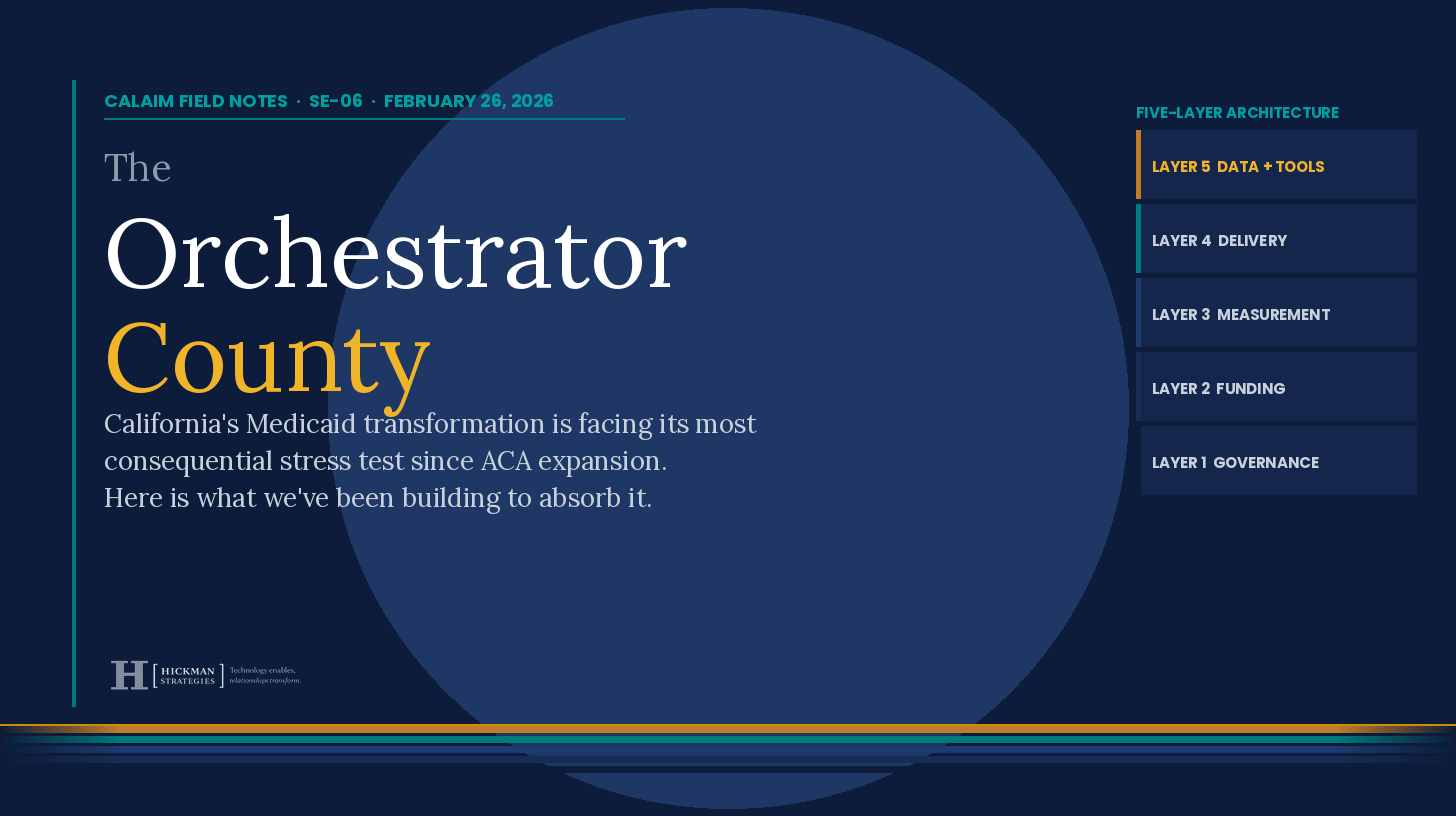
California’s Medicaid transformation is facing its most consequential stress test since ACA expansion. The infrastructure to answer it already exists. Here is what it looks like.

1. The Stress Test
California’s county associations did the math this week. The numbers are not theoretical.
CSAC, the County Welfare Directors Association, the California Association of Public Hospitals, and CHEAC released a joint fiscal impact analysis of H.R. 1. The combined annual cost to California counties: $6 billion to $9.5 billion. That breaks down to $2B–$5.5B for indigent care — people who lose Medi-Cal and have nowhere else to go; $3.4B in public hospital revenue losses from State Directed Payment cuts; and nearly $600M in county workforce costs just to administer the new eligibility requirements.
Here is what that number obscures: counties have no capacity to absorb it. Under AB 85 in 2013, California redirected 1991 Realignment indigent care dollars to the state. Most Article 13 counties dismantled their indigent care infrastructure after ACA expanded Medi-Cal. The infrastructure that was supposed to catch people who fell through the coverage gap no longer exists. Counties are being asked to absorb somewhere between 417,000 and 1.3 million newly uninsured residents into a system they reasonably believed they would never need again.
The counties we work with on CalAIM implementation are the same counties facing $6B–$9.5B in new costs. That is not a coincidence. It is a stress test for infrastructure that was never fully built.
State Medicaid Director Tyler Sadwith put the official DHCS headline plainly at the All-Comer Webinar: up to 2 million Medi-Cal members risk losing coverage. The phased projections are precise — up to 233,000 lose coverage by June 2027, up to 1 million by January 2028, up to 1.4 million at full implementation. The DHCS Implementation Plan is honest about its own limitations. DHCS is banking on ex parte automatic renewals to keep eligible members covered without burdening them or counties. That is the right bet. But the plan acknowledges that ex parte rates dropped back to pre-unwinding levels after federal flexibilities ended in July 2025. The automation worked until it didn’t. The county workforce question — what 58 counties actually need to execute six-month renewals, work requirement verification, and increased foot traffic — is named but not quantified.
Here is what neither analysis captures: every member who churns off Medi-Cal is an ECM care plan that dies. A Community Supports referral that resets. A trust relationship that took months to build. The California Budget & Policy Center has documented how coverage losses threaten CalAIM Community Supports that have already reached 430,000 Californians. The DHCS All-Comer Webinar adds a number that puts this in operational terms: approximately 2.8 million new adult group members are expected to require manual verification when automated ex parte checks fail. DHCS estimates up to 50% of those members could lose coverage from paperwork burden alone — not because they are ineligible, but because the administrative system cannot reach them in time. That is the governance gap made visible. The counties with trusted CBO relationships are the ones positioned to bridge it. The counties without them are not.
This is not a technology gap. It is an orchestration gap. The question is whether we connect the CalAIM implementation experience to the coverage loss response at the scale this moment requires.
2. The Structural Paradox: Ecosystem Aspiration, Network Chassis
California built its “no wrong door” ecosystem — Whole Person Care, then CalAIM — on top of Medi-Cal’s managed care infrastructure. The logic was sound: MCPs provide the financial architecture that makes Enhanced Care Management and Community Supports possible at scale. Without managed care, CalAIM has no funding mechanism.
Four years in, the CPI collaborative sees both the power and the tension of that choice. Network models create doors by design. A member who walks into a CBO contracted with one plan but enrolled in another hits a boundary that “no wrong door” promised to eliminate. The managed care contracting model — the very infrastructure that funds CalAIM — also fragments it.
H.R. 1 makes this tension acute. When a member loses coverage and re-enrolls — possibly in a different plan after a gap — their ECM care plan, their Community Supports referral chain, and their care team relationships do not automatically follow. The network model has no memory across churn. The ecosystem aspiration requires continuity infrastructure that the network chassis does not provide by design.
From four years of that field work, I believe there is a third path — and the PATH/CPI collaborative has been prototyping it. Not dismantling managed care’s financial infrastructure — it is too valuable. Not accepting network boundaries as given — the ecosystem aspiration is too important. An orchestration layer that sits across network boundaries and connects the ecosystem intentionally. The PATH/CPI convenings bring MCPs, CBOs, county agencies, and providers to the same table regardless of which plan contracts with which organization. That architecture — trusted, sustained, cross-boundary — is what makes continuity of care possible when members churn.
AI amplifies this question. The emerging field of AI-powered care navigation raises the same governance problem from a different direction: when AI frees clinical and administrative capacity, where does that capacity go? We have a name for the answer we’ve been building toward in CPI work — orchestration over digitization. Technology identifies who needs to be reached. Relationships determine whether they get there. Under H.R. 1, freed capacity can flow toward absorbing a coverage crisis — proactively reaching members at risk of losing Medi-Cal, triaging churn, rebuilding disrupted care plans. Or it can flow toward volume. That choice is a county-level design decision. It cannot be made at the provider or platform level. It requires the governance layer the Orchestrator County provides.
3. What the Capital Side Confirmed
Last week I spent a day at a UC Berkeley School of Public Health convening in my role as a volunteer with the Innovation Program. I went in expecting to be challenged. What I found instead was a mirror.
What I’m naming here is what the experience confirmed about work I’ve been doing independently for four years — not a summary of the day. The same diagnosis I’ve been building toward from the coordination side arrived from a completely different direction. That convergence is what matters.
From where I sit in PATH/CPI facilitation: the counties that struggle with CalAIM are not short on technology, federal guidance, or even intent. They are short on governance architecture — a trusted backbone capable of braiding together the tools and relationships that already exist. I’ve been watching that bottleneck form for four years. What the day confirmed is that the same bottleneck appears when you approach this question from the capital side.
Here is why capital does not flow toward backbone coordination specifically: investment instruments require a counterpart that can receive, deploy, and account for capital across multiple funding streams simultaneously.
MCPs can do this within their network. Health systems can do this within their institution. CBOs — even excellent ones — typically cannot do this across plan boundaries without a governance layer above them. The I-Bank needs a creditworthy borrower. COIN needs a community development pipeline. Pension fund criteria need a measurable community health counterpart. None of these instruments are broken.
All of them are waiting for the same thing: a trusted county-level entity that can hold the relationship across the funding streams, across the plan boundaries, and across the political cycles long enough for capital to recognize it as infrastructure rather than overhead.
It is not a capital supply problem. It is a governance architecture problem. Capital cannot flow where there is no trusted entity to receive it, hold it across funding streams, and account for it to communities rather than just to payers. That is what four years of CPI work has been building. That is what the capital side confirmed.
The capital stack exists. CalPERS and CalSTRS manage approximately $950 billion in combined assets. Health conversion foundations — created when nonprofit hospitals and health plans convert to for-profit status — collectively hold over $40 billion nationally across more than 300 foundations, with California home to some of the largest. California’s I-Bank provides loan guarantees — up to $5M for smaller projects, $5M–$30M for community infrastructure via Climate Catalyst. COIN, administered by the California Department of Insurance, connects insurers to community development investment. MCP community reinvestment obligations of 5–7.5% of net profits are due Q3 2026.
None of these require new legislation. All of them require the same thing: a trusted county-level entity that can receive capital, hold the governance relationship across funding streams, and account to communities rather than just to payers.
One important caveat: the community reinvestment mechanism applies only to plans with positive net income. H.R. 1’s projected $3.4 billion in State Directed Payment losses to public hospitals, combined with enrollment volatility, puts MCP profitability under real pressure. Plans that report operating losses owe nothing. The Q3 2026 window is real — but its size is contingent on financial conditions that H.R. 1 threatens directly. This makes moving before the window closes more urgent, not less.
4. The County Orchestrator Model: A Layer Cake
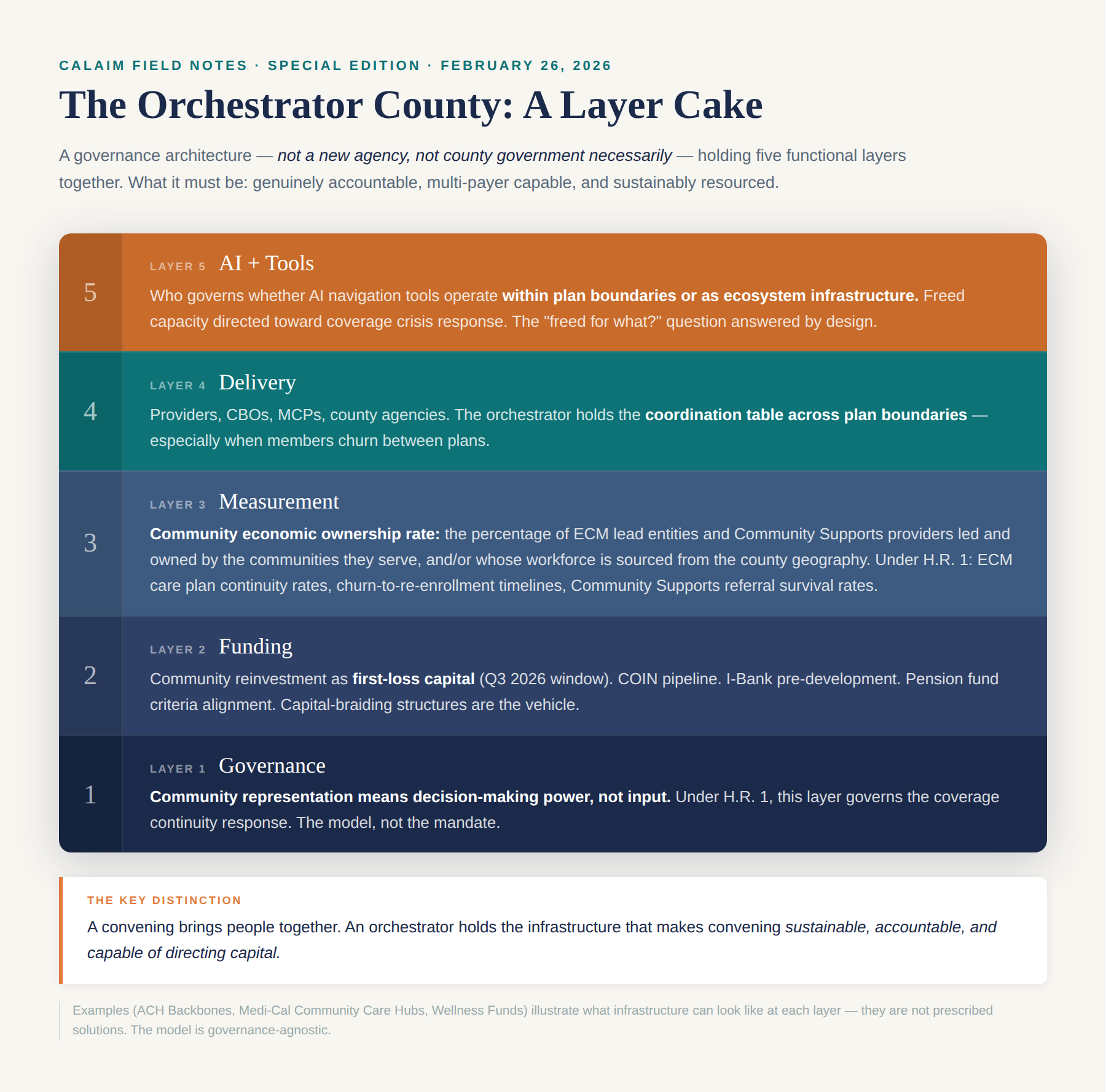
The County Orchestrator is not a new agency or technology platform. It is a governance architecture — a trusted backbone that holds together five functional layers across the county ecosystem.
Layer 1 is governance: who sets direction, with community representation meaning decision-making power, not input.
Layer 2 is funding: community reinvestment as first-loss capital, sequenced with I-Bank, COIN, and pension criteria toward equity rather than extraction.
Layer 3 is measurement: shared outcomes across the partnership — under H.R. 1, that means ECM care plan continuity rates, churn-to-re-enrollment timelines, and Community Supports referral survival rates.
Layer 4 is delivery: providers, CBOs, and county agencies — organized through Community Care Hubs that aggregate CBO capacity within plan networks, and ACH backbones that hold coordination across plan boundaries when members churn.
Layer 5 is data and tools: before governing AI navigation tools, a county needs a shared data layer that CBOs can actually access across plan boundaries. Referral platforms don’t talk to each other. Smaller organizations have no way to measure system-wide outcomes.
That fragmentation is as absent as the governance layer — and as fundable through the same Q3 2026 reinvestment window. AI governance — whether navigation technology operates within plan boundaries or as ecosystem infrastructure — is the next-level question. But it cannot be answered well without the shared data layer underneath it.
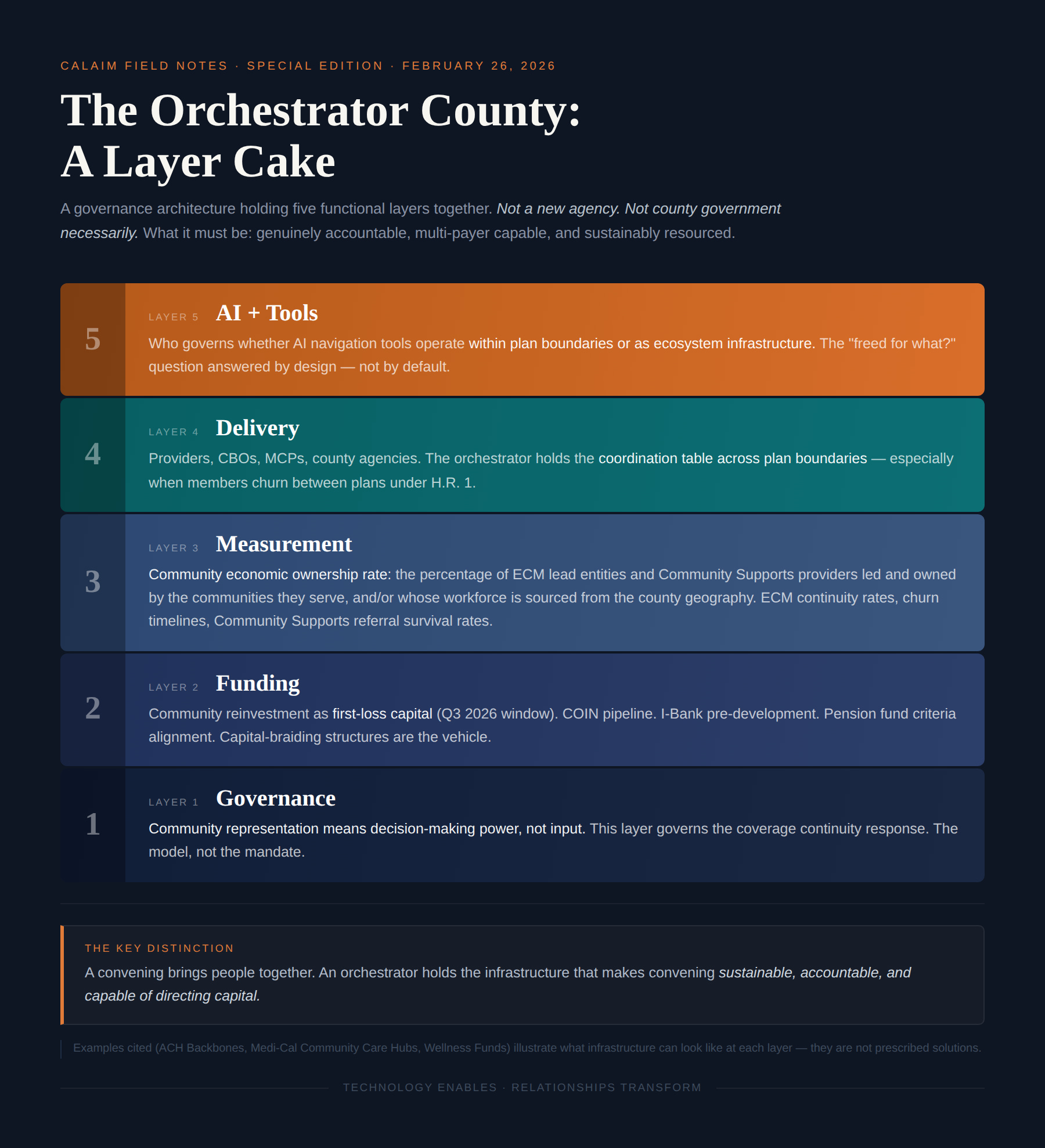
The full architecture — including the CCH/ACH layer detail and H.R. 1 use case framework — is available in the linked working document here. What matters here is the organizing principle: the Orchestrator does not replace any of these layers. It connects them. The backbone is the glue — and without it, each layer functions in isolation while members fall through the seams.
THE H.R. 1 USE CASE FOR THE ORCHESTRATOR LAYER
→ Governance: Who convenes the county-level response across MCPs, CBOs, county agencies, and hospitals?
→ Funding: Can community reinvestment dollars be directed to churn-prevention outreach and re-enrollment infrastructure?
→ Measurement: Are we tracking ECM care plan continuity rates as coverage churns?
→ Delivery: Which CBOs have the trusted relationships to reach members before they disappear from the system?
→ Data + Tools: Are referral platforms built to follow members across plan changes, or locked to enrollment snapshots? Is there a shared data layer CBOs can access?
The Orchestrator County does not need H.R. 1 to justify its existence. But H.R. 1 makes the cost of not having it visible in a way that four years of field work has not.
5. The Trust Condition: Infrastructure Under Compression
The DHCS Implementation Plan describes a “significant increase in manual administrative workload” at county level from six-month renewals, work requirement verification, and increased foot traffic. It names the problem. It does not quantify what 58 counties actually need to execute it. In CPI meetings, we hear the same thing from county teams: “We’re still catching up from unwinding. Now this.”
The counties absorbing nearly $600 million in new workforce costs to administer eligibility requirements are the same counties where PATH/CPI has been building cross-sector coordination infrastructure for four years. That infrastructure is at risk of sunsetting just as it becomes most operationally valuable. The Camden Coalition’s Ecosystems of Care framework names this explicitly: backbone coordination is a sustainability domain, not overhead. It requires dedicated investment like any infrastructure.
Our Cell Phone Test data tells the story at the county level: only 22% of county partners text or call each other directly when issues arise. That gap — from formal to trusted — is the infrastructure challenge no procurement will solve. It is also the gap that determines whether CalAIM’s response to H.R. 1 is coordinated or fragmented.
The Cell Phone Test is also a Layer 3 measurement instrument. A county that moves from 22% to 50% direct-contact relationships has documented, verifiable backbone infrastructure progress — the kind that investors, MCPs, and county leadership can see and resource. Relational capital is not soft. It is the infrastructure outcome that precedes every other outcome on the Layer 3 dashboard.
Trust is infrastructure. The relational capital that PATH/CPI collaboratives have built over four years cannot be reconstructed quickly if it sunsets now. And we cannot afford to reconstruct it during a coverage crisis.
FOUR CONVERGING DATES — ONE SIX-MONTH WINDOW
OPPORTUNITY → July 1, 2026: CalPERS Total Portfolio Approach goes live. The governance architecture that enables health equity criteria to enter CalPERS investment conversations becomes formally operational. A policy memo connecting community health infrastructure to TPA criteria needs to be in front of CalPERS investment staff before this date, not after.
DEADLINE → Q3 2026: MCP Community Reinvestment plans due. Backbone coordination infrastructure must be named explicitly. Plans that don’t name it won’t fund it — not for three years. Reinvestment pool size is contingent on MCP profitability, which H.R. 1 threatens.
DEADLINE → December 31, 2026: California’s MCO Tax structure expires. CMS finalized this February 2. The MCO Tax funds the rate increases underpinning much of CalAIM. Its expiration coincides with H.R. 1’s first major implementation wave.
DEADLINE → January 1, 2027: Three major changes arrive simultaneously for the new adult group — work and community engagement requirements, semi-annual redeterminations, and copayments. All three land on the same date.
One opening window. Three converging pressures. All in the same six months. The Orchestrator County infrastructure needs to be resourced before they land together.
6. What We Do Now
The Orchestrator County is not a future state. It is the pattern already operating across California in at least six distinct organizational forms — and recognizing that is the innovation of the obvious.
CACHI’s 36 Accountable Communities for Health are the clearest expression: county-level backbone organizations explicitly aligned to CalAIM, convening MCPs, CBOs, LHJs, and county agencies across plan boundaries — state-funded and community-governed. The California Improvement Network holds that same cross-sector connective function at the statewide level. BH-CONNECT is building the behavioral health version of the same architecture. Medi-Cal Community Care Hubs are building the Network Manager version — neutral back-office infrastructure aggregating CBO capacity within plan networks. Local health foundations — like the Northern Sonoma County Healthcare Foundation, now running quarterly CalAIM CBO coalitions with shared technical assistance and infrastructure — are doing it without the label. And PATH CPI has been doing it in facilitated form across California counties for four years.
The architecture already exists. It operates under different names in different counties. A January 2026 national field scan by Convergence independently arrived at the same conclusion: coordination infrastructure for health and social care ecosystems remains structurally underfunded, with coordination labor, data platforms, and evaluation capacity systematically undervalued by public and private payers. What it does not yet have, in most California counties, is a named line in a managed care plan’s community reinvestment plan — which means when Q3 2026 passes, it will not have sustainable funding for the stress test it is being asked to absorb.
Not all backbone organizations are the same, and MCPs, investors, and county agencies need to know the difference before Q3 2026. Network Manager hubs — like Community Care Hubs and Pathways Community HUBs — provide contracting, data systems, referral management, compliance, and administrative support to networks of CBOs. They are neutral infrastructure: the back office that smaller organizations cannot afford to build individually. Service-centered organizations with backbone capacity — FQHCs, some ACHs, some health foundations — deliver care directly and coordinate partners, but their backbone function is secondary to their service mission.
The Orchestrator County needs both, but it is not both. The backbone is the governance and administrative layer that holds the delivery system together. Conflating service providers with backbone infrastructure is how counties end up with coordination that works when funding is aligned and fractures when it isn’t.
One more honest note: in counties where multiple organizations claim backbone functions, the Q3 2026 reinvestment conversation is also a political negotiation, not just a naming exercise — and MCPs that prefer to fund direct services over coordination infrastructure will find willing partners on both sides of that debate. Knowing that going in is not a reason to avoid the conversation. It is a reason to bring evidence.
In counties where no formal ACH, CIN anchor, or health foundation backbone currently operates, those communities are not missing the concept — they are missing the recognition. The same Q3 2026 reinvestment window that resources existing backbones can seed new ones, built from what already exists: a willing LHJ, a strong CBO coalition, a PATH CPI table that could be anchored rather than facilitated.
FOR MANAGED CARE PLANS
The Q3 2026 community reinvestment plan is the instrument. Backbone coordination infrastructure — convening capacity, churn-response outreach, cross-boundary data governance — belongs in that plan by name. If it isn’t named when the plan is filed, it won’t be funded for three years. That unfunded gap is exactly when H.R. 1’s first wave lands, the MCO Tax expires, and the January 2027 simultaneous changes arrive. The window to name it is now, not after the window closes.
FOR CACHI ACHS, CIN PARTNERS, HUBS, HEALTH FOUNDATION BACKBONES, AND COUNTY TEAMS
You are the organizational form this model describes. The Q3 2026 reinvestment window is the moment to name backbone functions explicitly in MCP reinvestment plans — convening, data governance, coverage continuity outreach — and to make the case, with evidence, that those functions belong in the reinvestment portfolio as infrastructure investment, not as overhead. In counties where no formal backbone exists yet, the same window seeds one: a willing LHJ, a strong CBO coalition, a PATH CPI table that could be anchored rather than facilitated. The architecture is available. The moment to resource it is specific.
FOR HEALTH SYSTEMS, CDFIS, IMPACT INVESTORS, AND PENSION FUND STAFF
The first-loss capital question is live. Community reinvestment dollars can de-risk I-Bank loans, open COIN pipeline deals, or capitalize direct community health infrastructure investment. CalPERS TPA goes live July 1 — that is the moment to be in the investment criteria conversation, not after it. The governance architecture that makes these instruments work is being built right now, in counties across California. The question is whether the capital side shows up before Q3 2026, or after.
We do this work because we believe it is possible — not just theoretically possible, but now-possible, here-possible, with-these-people possible. The stress test does not change the thesis. It confirms it.
The full architecture — including the CCH/ACH layer detail and H.R. 1 use case framework — is available in the linked working document here.
Technology enables. Relationships transform.
Start with the willing. Scale to the system.
A Note on Sources and Scope
This edition draws on four public sources: the CSAC/CWDA/CAPH/CHEAC joint fiscal impact analysis (February 2026), the DHCS All-Comer Webinar implementation plan, a January 2026 national field scan by Convergence on community hub models and coordination infrastructure financing, and four years of PATH/CPI field observations across California counties. The capital stack analysis draws on publicly available data for CalPERS, CalSTRS, COIN, the I-Bank, and DHCS managed care contract requirements.
The Berkeley section reflects my personal synthesis as a practitioner. The convening — “Reimagining Financing and Capital Flows for Health Equity” — was organized by Dr. Rishi Manchanda and the teams at HealthBegins, UC Berkeley School of Public Health Social Impact Team, and the Common Health Coalition. This section is not a summary of the day’s discussions or conclusions. The full County Orchestrator architecture table, CCH/ACH layer detail, and H.R. 1 use case framework are available in the linked working document.
Sources: CSAC/CWDA/CAPH/CHEAC Joint Fiscal Impact Analysis (Feb 2026) · DHCS All-Comer Webinar / Tyler Sadwith · California Budget & Policy Center · CalPERS Board (Nov 2025) · Commonfund Institute (Oct 2025) · CACHI Community Profiles · Convergence Community Hubs Field Scan (Jan 2026). Full sourcing with 17 citations available in the linked working document. Questions on sourcing: jim@hickmanstrategies.com

Jim Hickman is the Principal of Hickman Strategies LLC, a PATH/CPI Facilitator with the Camden Coalition, and a Venture Partner at Suncoast Ventures. He has spent four years facilitating cross-sector coordination across California counties under CalAIM.
To continue the conversation: calendly.com/jim-165/introductory-meeting
Orchestration over Digitization™ · Technology Enables · Relationships Transform™ · © 2026 Hickman Strategies LLC