
No. 20 | The Commission Keeps Describing a Gap No One Has Funded
Notes from Meeting #4 of the Future of Medi-Cal Commission, and the comment I put in front of the work groups

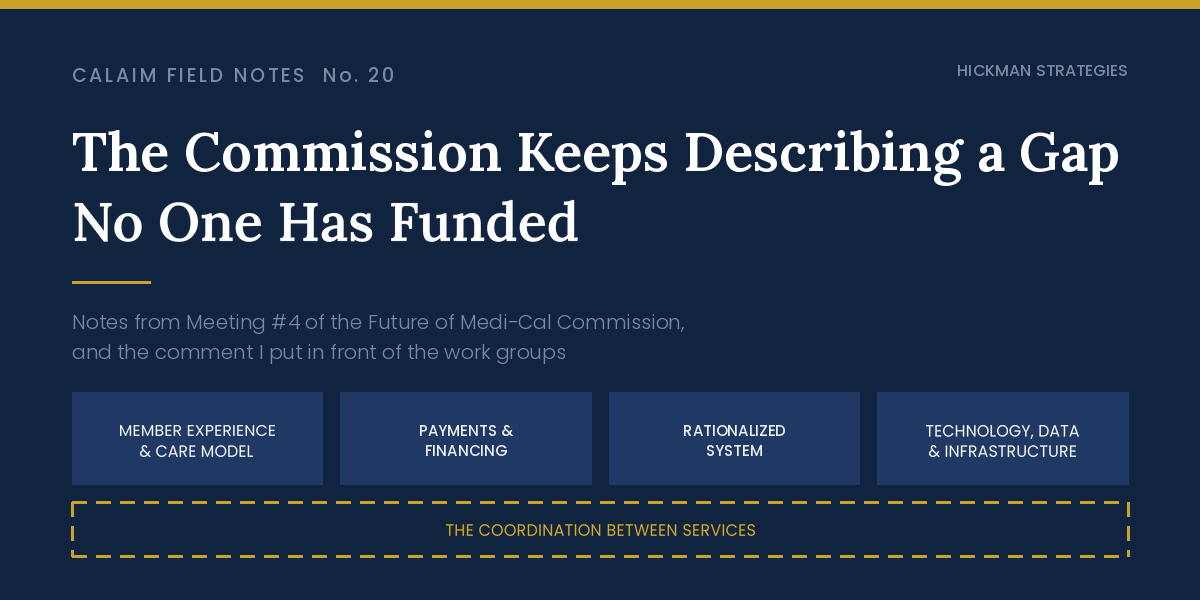
I joined Wednesday’s fourth meeting of the Future of Medi-Cal Commission by video. Four work groups reported out to co-chairs Dr. Mark Ghaly and Ann O’Leary, who want the whole effort to land on roughly five recommendations. Ghaly was firm about the test each one has to pass. Every recommendation must trace back to a principle the Commission has settled on, equity and access, accountability and outcomes, capability and innovation. In his framing, a slate that does not is a failure.
One thread ran under all four reports. I want to name it, then tell you what I filed in response.
The demand question is closing
DHCS reported nearly 227,500 people in Enhanced Care Management in the third quarter of 2025, up 59 percent from a year earlier, and 191,000 members using Community Supports in the same quarter. Enrollment in both is at a record, and the services themselves are no longer the open question. DHCS now finds ten of the twelve Community Supports it studied cost-effective. What the Commission spent the day circling was whether the system underneath those members can deliver the coordinated care the services promise.
The Rationalized System work group went around on one question and could not resolve it: who is ultimately accountable for a member across the departments of Health Care Services, Social Services, Developmental Services, and Aging. The one place it reached consensus was on sequence: simplification before integration. Fewer moving parts first, then the work of connecting what remains. That is a defensible order, and it puts the harder half second. Strengthening accountability and coordination is that group’s charter, so this is a gap the Commission assigned itself and has not closed. The Member Experience group named lapsed members as its most worrisome population, the ones who fall out of care and never reconnect. Rationalized System, with Technology, Data and Infrastructure, named real-time longitudinal data as the prerequisite for almost everything else. And the Payments group is designing a base-and-performance payment structure with no immediate place in it for the coordination that ties services together.
Four reports, one gap underneath all of them. The care sits in contracts. The coordination between services sits in nobody’s contract. Two of the four reports are really one report. Longitudinal data is what it would take to see a member whole, and accountability is hard to assign while no single view of the member exists, which puts the accountability question downstream of the data question. There is a way to test that. For a member enrolled in Enhanced Care Management and also receiving a Community Support, which of the four departments can produce a current view of everything that member is authorized for? Whoever can already answer is the candidate.
That gap is about to widen, and not by California’s choosing. The federal community engagement requirement arrives as an interim final rule, effective this Friday, July 31, with state implementation required by January 1, 2027. Comments close the same day it takes effect. The rule bars managed care plans from determining whether a member has met the requirement and restricts what they can delegate, which leaves the entities holding the richest claims and encounter data outside the determination that data would inform. Someone has to do that work. The rule names no one, and it carries no money.
The care sits in contracts. The coordination between services sits in nobody's contract.
What I put in the record
I facilitate CalAIM implementation across California counties and advise the plans, providers, and community organizations doing this work, so I filed a two-page written comment during the public session. It makes one argument: fund the coordination layer. Three actions, sized to the slate of five the co-chairs want. Between them they cover all three principles, each names a legislative, budget, or executive pathway, and each has a version that holds under today’s constraints.
Put coordination in the base payment tier, not the margin. The Payments group is already building the mechanism: base stability payments held separate from performance payments tied to outcomes. Coordination belongs in the base, because plans and providers cannot produce the outcomes the performance tier will measure without it. Funded as a line, it stops competing against direct service every budget cycle. The case for a line rather than a margin got sharper on July 21, when CMS deferred $867.5 million in federal matching funds to California pending documentation supporting the underlying claims. Work that lives in overhead is the hardest work in the system to evidence when someone asks to see it.
Name a local owner. The Rationalized System work group’s unresolved accountability question has a practical answer: designate a local orchestrator accountable to the care model rather than to a single funding stream, with a defined role in the regional structures the group is mapping. That mapping will show where the state’s investments in Enhanced Care Management, Community Supports, and behavioral health sit. Someone then must be authorized to act on it, or the work produces a description of the system instead of a change to it. The federal rule has now put a date on that question. Whoever California names to hold accountability for a member will also have to hold the exemption and verification work when the requirement goes live.
Use coordination as the retention and learning instrument. The organizations closest to members hold the freshest contact information in the system and the relationships that make outreach land, and in the counties I work in it is personal outreach, not mail alone, that moves people through a renewal. That churn is not hypothetical. CHCF’s enrollment tracking shows Medi-Cal down about 5 percent between June 2025 and March 2026, from 14.78 million to 14.05 million, a loss of roughly 730,000 people. More than half of that decline, some 378,000 people, came in the first quarter of 2026 alone. The pace is accelerating, and all of it sits before H.R. 1’s major provisions take effect. Demand for the benefits is at a record while the base beneath them shrinks.
Fund and instrument those organizations, and coordination becomes the retention mechanism for a redetermination cycle moving to twice a year, and a live data source for the oversight the work groups said they lack. It also builds the feedback loop the meeting named as missing, because that is where an intervention’s effect shows up in weeks instead of in a two-year-old evaluation.
The comment carried one exhibit: a readiness assessment I use with frontline organizations across the state, mapping four layers of organizational capacity against four stages of maturity, with the managed care plan contracting floor marked. Most community organizations sit just below that floor, and the distance measures underfunded potential, not performance failure. The framework is not new. I published it in Field Notes No. 17 in May and presented it at the SCAN Foundation’s Bridging Capital and Care convening at UC Berkeley’s School of Public Health.
Work that lives in overhead is the hardest work in the system to evidence when someone asks to see it.
The asset a plan cannot buy
Underneath all four layers sits the one thing a plan cannot buy: the trust a community organization holds where it works. That is what speakers were describing when they talked about being present at the hardest moments, and about already holding the member data and relationships the work groups kept asking for. Coordination is what makes that trust usable at the scale a state contract requires.
Public comment on Wednesday cautioned the Commission against relying on efficiency gains to fund what comes next. The harder question sits one step back. Efficiency asks whether we are doing things right. Readiness asks whether the organizations we are counting on can do the thing at all, before we align payment and policy on top of them. That question comes first.
I am developing this argument with colleagues at the Camden Coalition, and that fuller version is headed for Health Affairs. A closer read of the four reports, and where I think the order of operations sits, is coming here in two weeks. The Commission is doing serious work under real fiscal pressure. The recommendation I will be watching for is the one that treats provider readiness, and the coordination it enables, as infrastructure worth financing rather than a box checked the day a contract is signed.
Efficiency asks whether we are doing things right. Readiness asks whether the organizations we are counting on can do the thing at all.
Five recommendations are a tight number. If only one of these three fits, it should be the second, because the other two describe how a named owner gets funded and instrumented. I hope one of the five is this one.
Jim
CalAIM Field Notes is a working notebook for the possibilists inside CalAIM. If a colleague on a county, plan, or community team would find this useful, send it their way.