

A health system partner pinged us this week with the question coming up across operator calls: Is ECM getting cut?
The headline read is understandable. The policy read is the opposite.
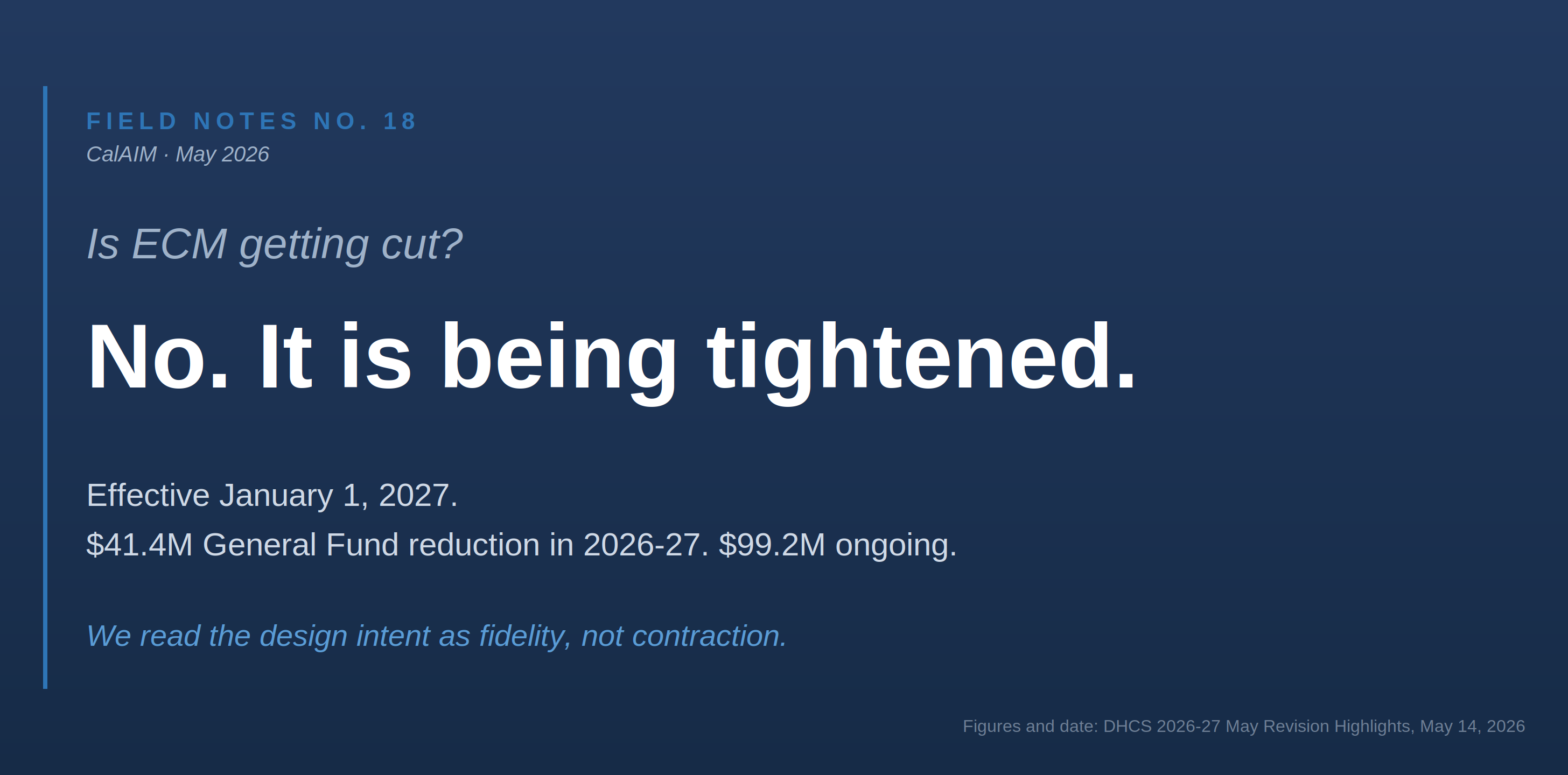
Enhanced Care Management is being refined, not retired. The May Revision released May 14 proposes changes to eligibility, service definitions, utilization management, and payment for ECM and Community Supports effective January 1, 2027. The fiscal line is real. The Department of Health Care Services projects a General Fund reduction of $41.4 million in 2026-27 for ECM, growing to $99.2 million ongoing. Community Supports tightens in parallel: a $26.9 million General Fund reduction in 2026-27, $51.0 million ongoing. The design intent behind the dollars is fidelity to the high-touch, person-centered model the benefit was originally built for.
What is actually changing inside ECM
The Department is driving fidelity to the original service model. Three areas worth holding clearly:
Service intensity. Refined utilization management criteria and payment adjustments target low-touch delivery (predominantly remote, generalized, or non-individualized care management). Capitated rates will adjust for low-intensity utilization, and risk corridors tighten. Plans we work with are translating this into operator-level floors well above current averages.
Tighter graduation and duration. Eligibility and duration criteria are sharpening to end extended periods of low-intensity service.
Reinforced non-duplication. The standing ECM exclusions for Behavioral Health Targeted Case Management, High-Fidelity Wraparound, and 1915(i) waiver care management remain the floor. Plans are sharpening enforcement so members are not enrolled in concurrent care management that the program was not designed to support.
A Medi-Cal plan recently walked operators through what this means on the ground. The Department’s intended footprint for ECM has always been a focused share of membership. Current enrollment in this plan’s region sits well above that share, with average encounters per member tracking below the underlying outcomes evidence for the benefit. The orientation is consistent across the plan briefings we have read: high acuity, high touch, in person where possible, with documented results.
We read it the way they read it. This is a protection of the program, not a contraction of opportunity. Back to basics, in the most operationally useful sense of the phrase.
What is also moving on January 1, 2027
Two changes worth holding alongside the ECM refinement.
Community Supports tightens in parallel. Refined referral pathways, eligibility criteria, service definitions, and utilization management criteria for selected services. We will go deeper in Field Notes No. 19.
A separate federally-driven change moves approximately 2 million state-funded immigrant Californians from managed care to fee-for-service on the same date. Because ECM and Community Supports are managed care benefits, this population loses access to both. The Department projects a $583.8 million reduction ($471.6 million General Fund) in 2026-27 and $1.5 billion ($1.2 billion General Fund) ongoing. For safety-net providers and hospitals serving large undocumented populations, this is the largest operational change in the budget. It is distinct from the refinement, and worth naming as such.
The operator work between now and January
For CBOs and providers reading this, the summer work is articulation, not access defense.
Audit current encounter cadence against high-touch standards. Where the data shows broad but shallow, the work between now and 1/1/27 is rebuilding to the model the benefit was designed for.
Reconcile overlap with Behavioral Health Targeted Case Management, High-Fidelity Wraparound, or 1915(i) waiver care management. The standing exclusion is being enforced. Organizations that wait until January will reconcile in arrears.
The Readiness Architecture we use with partners (Trust before Capabilities, Capabilities before Infrastructure, Infrastructure before Financing) was diagnostic when we built it. The 1/1/27 refinement makes it predictive. Counties that hardwired the lower layers absorb tighter eligibility frames gracefully. Organizations starting from Financing read refinement as cut.
Scale to Partnership
Counties that orchestrate well across plans, providers, and CBOs will find the January 1 transition does what good policy should: protect the program from drift. Technology enables. Relationships transform. Orchestration over digitization.
The constraint is not a limitation. It is the condition under which the next generation of CalAIM capacity emerges. The window between now and 1/1/27 is when the orchestration work pays off.
If you are reading the refinement from inside your county (plan, provider, CBO, or county orchestrator), we would value hearing your read. Reply and tell us what you are seeing on the ground.
Jim
A one-page field brief titled The May Revise and CalAIM: What Changes on January 1, 2027 is available for partners. Reply to this email and we will send it.
Primary sources: Department of Health Care Services 2026-27 May Revision Highlights, May 14, 2026 · DHCS Refinements and Efficiencies for ECM and Community Supports Fact Sheet, May 2026 · 2026-27 May Revision, Office of Governor Gavin Newsom, May 14, 2026 · First Look: Understanding the Governor’s 2026-27 May Revision, California Budget and Policy Center · Analysis of Governor Newsom’s May Revision, Western Center on Law and Poverty · 2026-27 Budget: Medi-Cal Analysis, Legislative Analyst’s Office.
Field Notes is a weekly dispatch from the work of orchestrating CalAIM. Published Thursdays on Substack.