

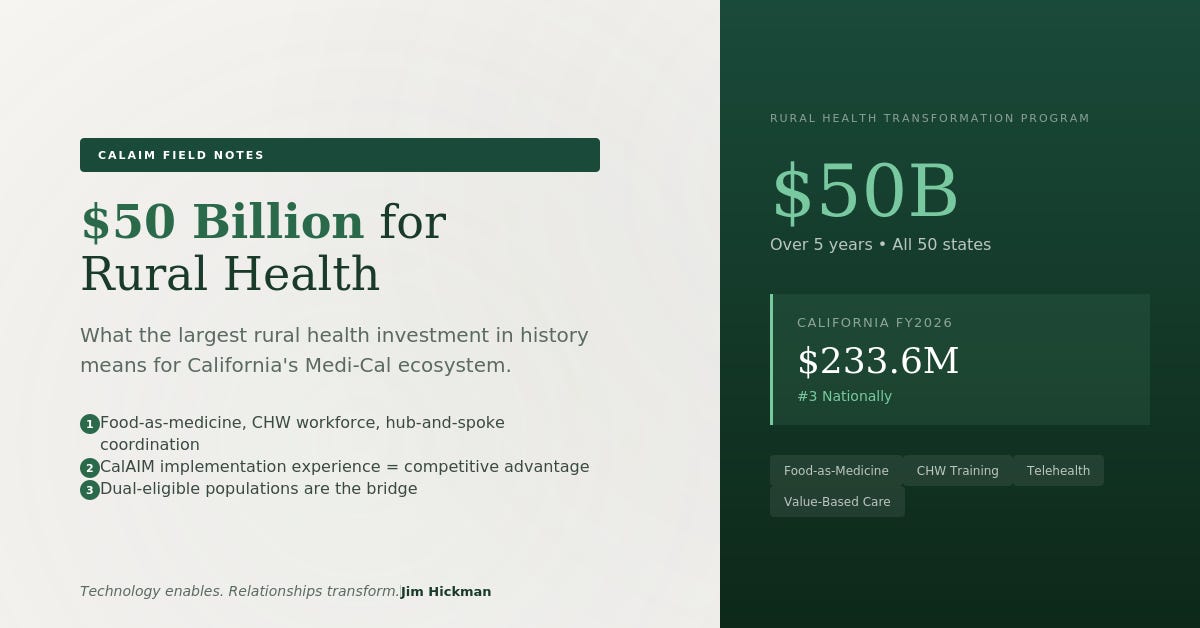
Yesterday, CMS announced the Rural Health Transformation Program—$50 billion distributed across all 50 states over five years. It’s the largest dedicated rural health investment in American history.
California’s Year 1 allocation: $233.6 million. That’s the third-highest in the nation, behind only Texas ($281M) and Alaska ($272M).
For those of us working in California’s Medi-Cal ecosystem, the program’s priorities read like a CalAIM implementation checklist.
What the Rural Health Transformation Program Funds
The program requires states to invest in at least three priority areas. Here’s where California’s plan focuses:
Food-as-medicine and chronic disease prevention. Sound familiar? This is the federal version of Community Supports—medically tailored meals, produce prescriptions, nutrition counseling. California’s been piloting these through CalAIM since 2022.
Community health worker infrastructure. Training, recruitment, retention. This is the workforce backbone of Enhanced Care Management. The promotora model that organizations like Good Samaritan have been scaling is exactly what CMS wants to see replicated.
Hub-and-spoke care coordination. Regional centers of excellence connected to community-based delivery. This is the architecture PATH CPI has been building across California counties for three years.
Telehealth and technology modernization. Remote patient monitoring, AI-assisted clinical workflows, cybersecurity. The digital infrastructure that makes distributed care coordination possible.
Value-based care pilots. Moving from fee-for-service to outcomes-based payment. The direction CalAIM has been pushing MCPs and providers for years.
What This Means for California
Three implications worth watching:
1. Rural counties get dedicated infrastructure funding. California’s Central Valley, North Coast, and mountain counties have struggled with provider shortages, facility closures, and transportation barriers. This is the first major federal investment specifically designed to address rural health infrastructure—not just coverage, but the actual capacity to deliver care.
2. CalAIM experience becomes competitive advantage. Organizations that have been implementing ECM, Community Supports, and care coordination under CalAIM now have a three-year head start. The models CMS wants states to build? California CBOs and MCPs have already been testing them. That operational knowledge is valuable.
3. Dual-eligible populations are the bridge. Rural California has a disproportionate share of Medicare-Medicaid dual-eligibles. These patients now sit at the intersection of two major federal investments: CalAIM’s ECM infrastructure and the Rural Health Transformation Program. MCPs running D-SNP plans should be paying close attention.
The Skeptical Note
A few cautions worth flagging:
Implementation timeline is aggressive. States have to show progress annually to maintain funding. CMS can reduce or terminate awards if states don’t hit benchmarks. That creates pressure for quick wins—which doesn’t always align with the slow work of building trust infrastructure.
State-level execution varies. California’s application scored well enough to earn the third-highest allocation, but how DHCS coordinates with the Rural Health Transformation Program alongside CalAIM implementation remains to be seen. Two major federal-state healthcare initiatives running in parallel creates complexity.
Policy alignment points matter. The scoring framework awarded points for state policy alignment with Administration priorities—including things like Presidential Fitness Test reinstatement and certain food policy positions. California’s policy landscape may not maximize points in future years depending on how scoring evolves.
The Bottom Line
This is validation.
The federal government just committed $50 billion to exactly the kind of community-based, relationship-driven, prevention-focused healthcare infrastructure that CalAIM has been building. Food-as-medicine. CHW workforce. Care coordination. Value-based payment.
For California organizations that have been doing this work—often without clear funding pathways or policy certainty—the message is clear: the model works, and now there’s federal money behind it.
The question isn’t whether the infrastructure is needed. It’s whether we can build it fast enough.
Technology enables. Relationships transform.
See you in the field.
—Jim
Read More Here:
• CMS Press Release (December 29, 2025): hhs.gov/press-room/cms-announces-50-billion-in-awards-to-strengthen-rural-health-in-all-50-states.html
• Rural Health Transformation Program: cms.gov/priorities/rural-health-transformation-rht-program/overview